
Too darn f*****g hot
Unusually hot weather is bad for you, your temper, your economy and your business. Climate change means you're going to get lots more of it.

We recently discussed the future economic costs embedded in every tonne of carbon dioxide the global economy emits. Carbon dioxide causes climate change. Climate change leads to a variety of unpleasant economic, social and financial costs.
And for those of us in western Europe, we’re experiencing them all right now. So far, our summer has been exceptionally hot. June temperatures were over 3oC hotter than their 1991-2020 average: a record. July has been similar.
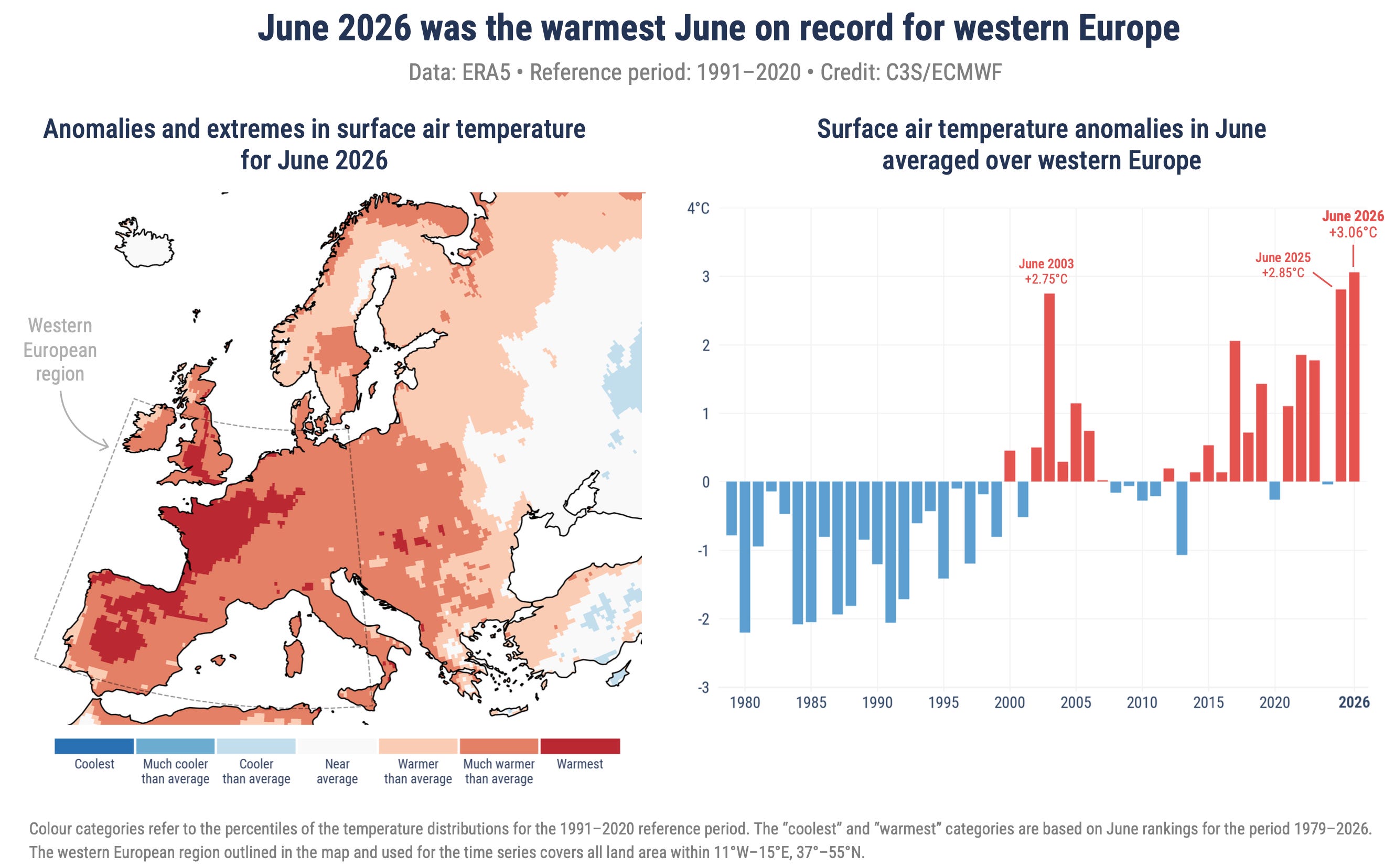
Source: Copernicus.EU
Exceptional heat is one of the most economically and socially harmful manifestations of climate change. What matters here is not so much that it’s hot, but that it’s much hotter than normal for the time and place. Our economies, societies, cultures and infrastructures are optimised to the prevailing climate of the past 200 years. Which is why 30oC heat is far more of a problem in London than it is in Madrid.
There are good physical reasons why exceptionally hot weather is a problem. The Second Law of Thermodynamics means that it takes more energy to cool something down than heat it up. And the Second Law of Wardrobes - coined by Professor Hendrik Woolf of the LSE - observes that there’s a zero lower bound on the clothes you can take off if you’re too hot. Once this Englishman is down to his Y-fronts and socks, we're done! But if I’m too cold I can always put on another jumper.
A key channel for extreme heat to hurt the economy is through higher energy use. The chart below shows that energy consumption rises sharply once temperatures climb above ‘comfortable’ levels. From a macroeconomic perspective, extreme heat is analogous to an energy shock: firms and households have to spend more of their incomes on electricity, squeezing their profits and disposable incomes.
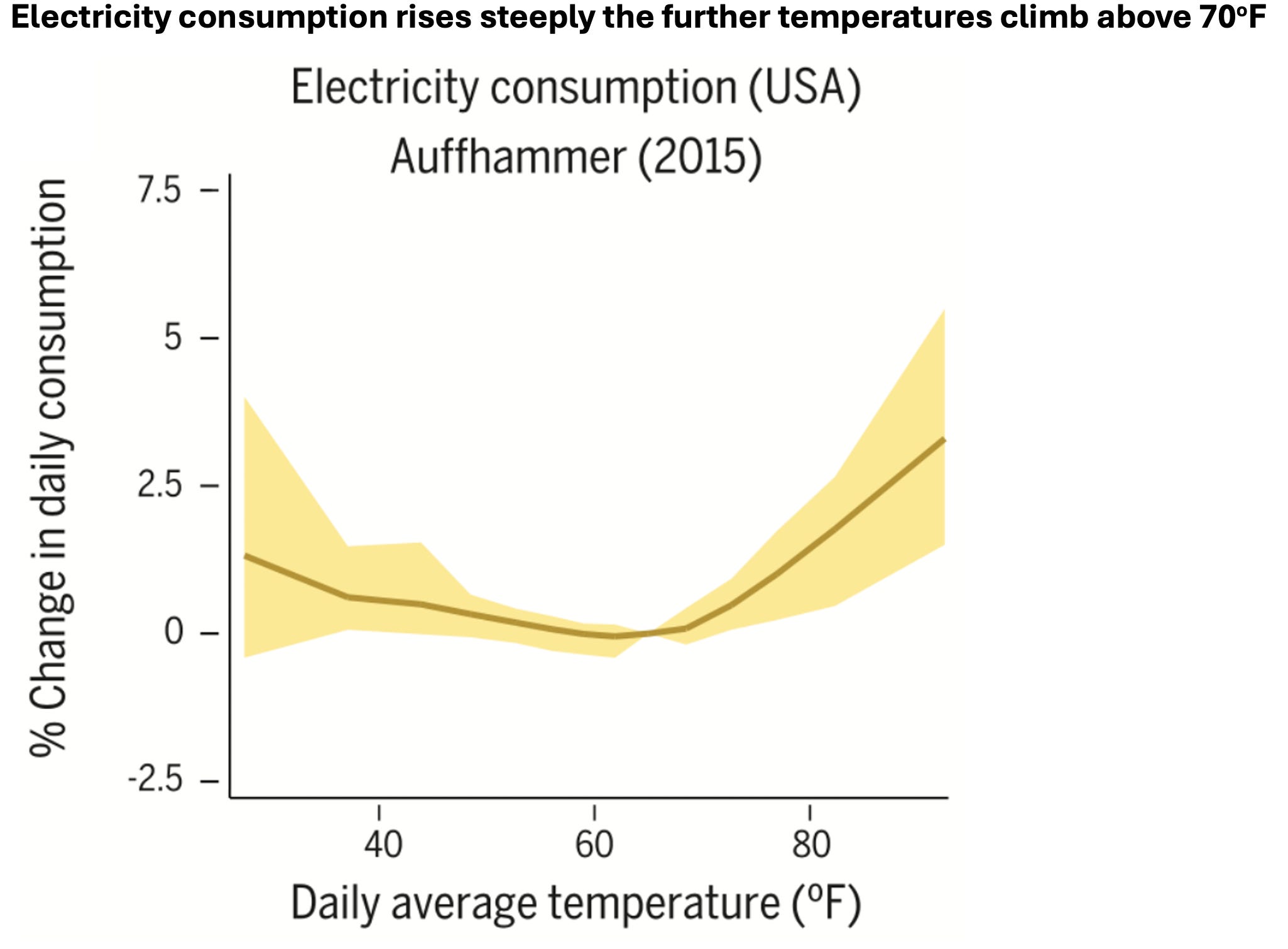
Source: Carleton, T.A. and Hsiang, S.M., 2016. Social and economic impacts of climate. Science, 353(6304)
That’s just the start. Exceptional heat has a wide range of negative effects. It reduces labour productivity and the number of hours worked1, putting a further drag on economic activity. If you thought you were doing a crap job during the recent heatwaves, you were right!
Heat makes you less productive because it is really, really bad for you. There’s widespread, robust evidence to show that it kills2. Indeed, the current heatwaves in Europe may have led to over 10,000 excess deaths. And people get sick too. Hot weather fills up hospital emergency departments. If you’re in A&E, you’re probably not that productive.
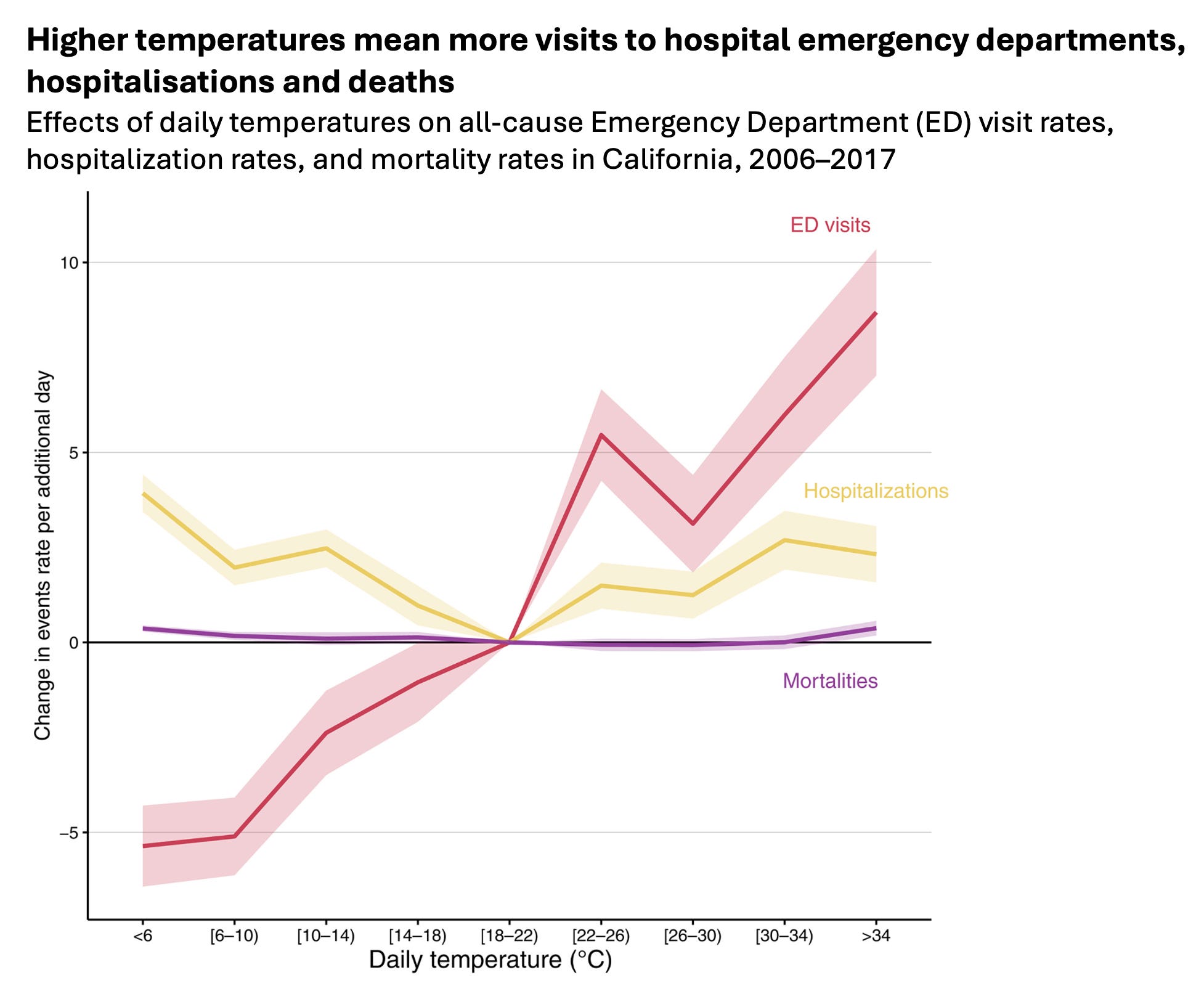
Source: Gould, C.F., Heft-Neal, S., Heaney, A.K., Bendavid, E., Callahan, C.W., Kiang, M.V., Graff Zivin, J. and Burke, M., 2025. Temperature extremes impact mortality and morbidity differently. Science Advances, 11(31), p.eadr3070.
Heat is also really, really bad for social interaction. Your teams might not display the best interpersonal skills when it gets too hot. As a recent paper3 put it:
a large and rapidly growing interdisciplinary body of research now affirms that higher than normal temperatures are associated with far greater risk of many forms of violence and conflict. In our view, this should now be seen as a robust social science empirical fact.
There’s amazing work to illustrate this. The charts below show estimates of the probability of a Tweet containing a profanity or negative emoji depending on the temperature (the paper it’s taken from was done in 2015, so before Twitter turned into the far-right cesspit it is today). Once temperatures rise above 70oF it all gets very 🤬 and 💩. So don’t go on social media when it’s hot. And definitely don’t schedule a difficult team call on Zoom either.
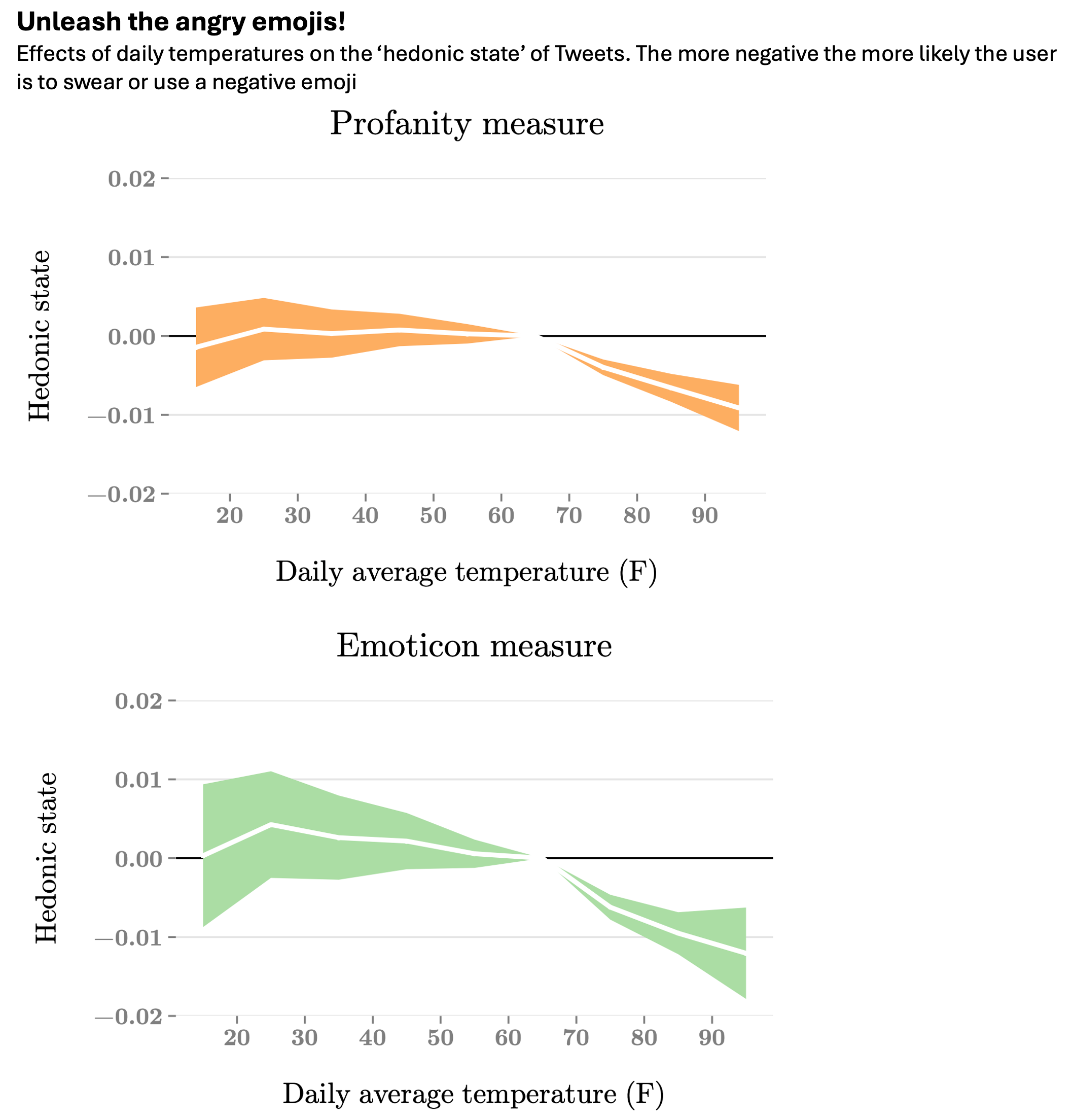
Source: Baylis, P., 2020. Temperature and temperament: Evidence from Twitter. Journal of Public Economics, 184, p.104161.
That’s because high temperatures are terrible for mental as well as physical health. Call volumes to telephone counselling services in Germany rise significantly once temperatures climb above 25oC4.
These micro effects scale to macro-economically significant impacts. A recent ECB paper5 showed that a summer heatwave (where temperatures are at least 1.5oC higher than normal) in the eurozone reduced GDP by 0.5%. Given the current heatwave is more than twice that threshold, European cyclical indicators could surprise to the downside in the next few months.
As this is more of a shock to supply than demand, extremely hot weather will also boost inflation: one paper6 has found that extreme temperatures push up both headline and food inflation over the coming year. Adding these heatwaves to the shocks to energy and fertiliser prices, and the incoming monster El Niño, 2027 is shaping up to be a ghastly year for inflation in Europe.
And it won’t just be bond investors feeling the heat. Exceptionally high temperatures lead to negative corporate earnings surprises, reporting lower revenues and operating incomes7.
In fact, those macro estimates mask huge differences at the firm level. A new paper looking at nearly 9 million European firms8 shows that the output of low productivity firms falls dramatically when temperatures are unusually high, to the point where a meaningful number of them go out of business. That may be because low-tier firms can’t afford to invest in adaptive technologies, such as air conditioning. Consequently, top-tier firms actually see their output rise as they eat up market share from weaker firms wilting in the heat. Looking at it another way, firms that are less prepared for extreme heat are more likely to lose market share and go out of business. Luck is being ready.
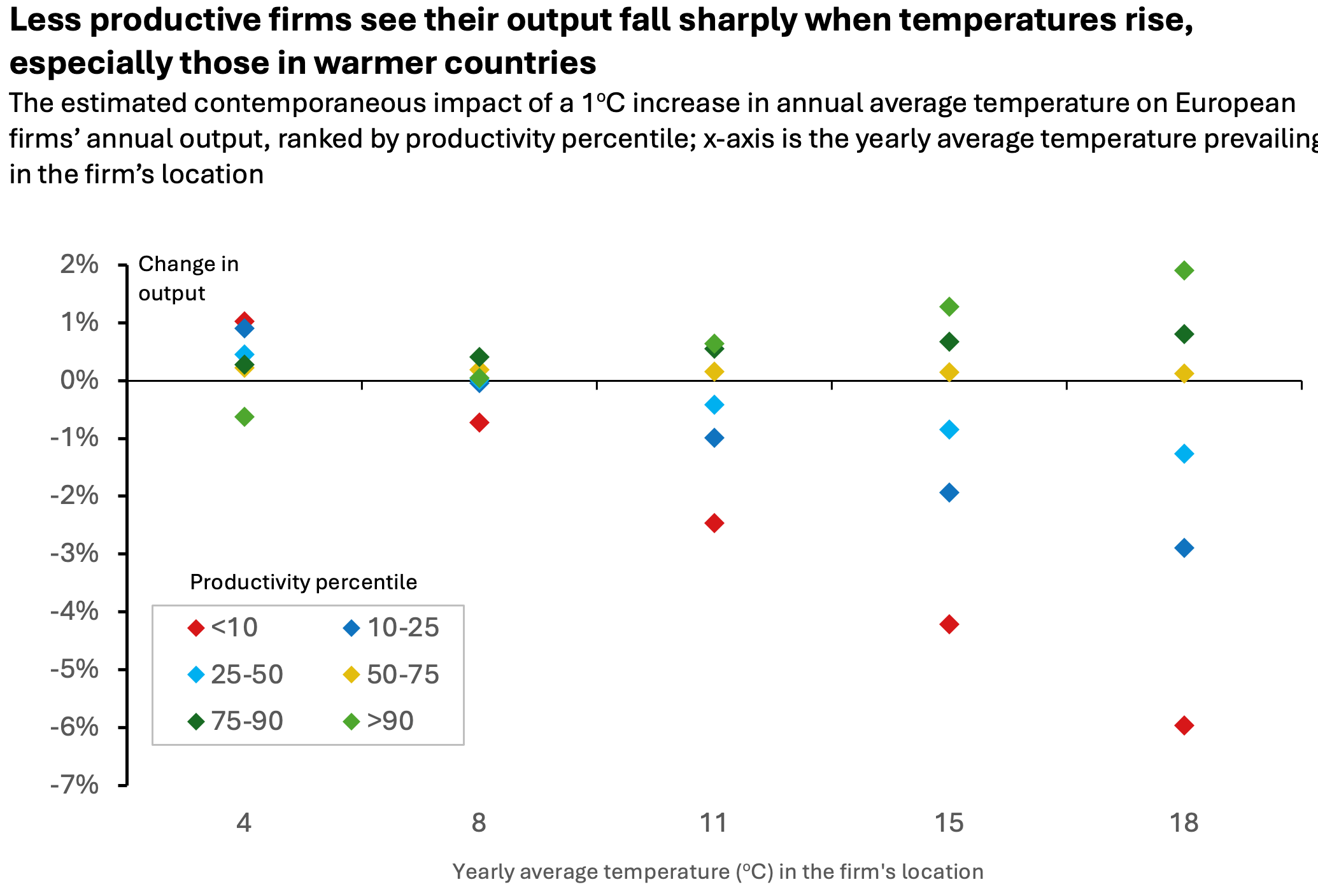
Source: Tarsia, R., 2026. Heterogeneous effects of weather shocks on firm economic performance. Journal of Environmental Economics and Management, p.103393.
Lower growth, higher inflation and earnings misses at the macro level. Sickness, higher energy costs, firm closures and angry staff at the micro level. These are just some of the costs of just one manifestation of climate change: extreme heat. We’re paying the price today and with summer temperatures in Europe rising at twice the rate of the rest of the world, we’re going to be paying an even higher price in the future.
Good luck keeping your cool!
Graff Zivin, J. and Neidell, M., 2014. Temperature and the allocation of time: Implications for climate change. Journal of Labor Economics, 32(1), pp.1-26.
Deschênes, O. and Greenstone, M., 2011. Climate change, mortality, and adaptation: Evidence from annual fluctuations in weather in the US. American Economic Journal: Applied Economics, 3(4), pp.152-185.
Burke, M., Ferguson, J., Hsiang, S. and Miguel, E., 2024. New evidence on the economics of climate and conflict. Handbook of the Economics of Conflict, 1, pp.249-305.
Janzen, B., 2025. Temperature and mental health: Evidence from helpline calls. Journal of the Association of Environmental and Resource Economists, 12(6), pp.1431-1457.
Usman, S., Fernández, G.G.T. and Parker, M., 2025. Going NUTS: The regional impact of extreme climate events over the medium term. European Economic Review, 178, p.105081.
Kotz, M., Kuik, F., Lis, E. and Nickel, C., 2024. Global warming and heat extremes to enhance inflationary pressures. Communications Earth & Environment, 5(1), p.116.
Pankratz, N., Bauer, R. and Derwall, J., 2023. Climate change, firm performance, and investor surprises. Management science, 69(12), pp.7352-7398.
Tarsia, R., 2026. Heterogeneous effects of weather shocks on firm economic performance. Journal of Environmental Economics and Management, p.103393.
Data centers currently use about 1.5% of global electricity (~415 TWh/year), and that’s growing ~12% per year, driven especially by AI workloads. Projections show this could more than double by 2030 to ~945 TWh, roughly the total electricity use of a country like Japan. In the U.S., data centers could account for almost half of electricity demand growth through 2030.
This has two main human impacts:
Higher strain on power grids, which can lead to reliability issues, higher prices, and pressure to build new generation (often gas or coal if renewables lag).
Greenhouse gas emissions, if the electricity isn’t from clean sources. Even with improving efficiency, absolute emissions can rise as total demand surges.